FILTER SYSTEMS
SERVICES
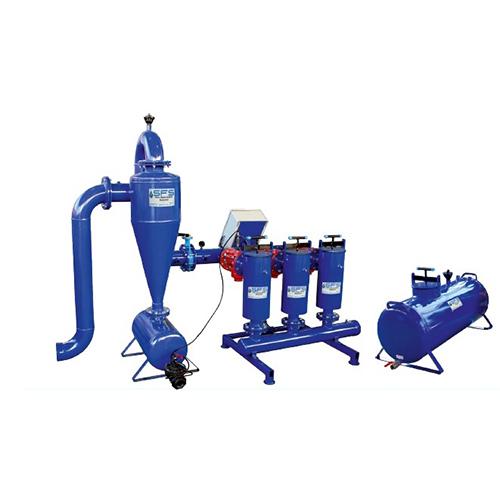
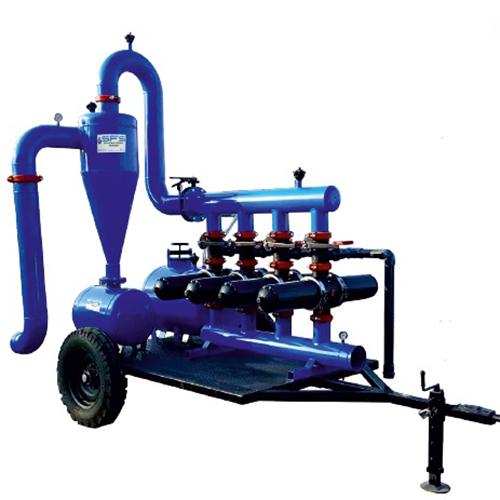
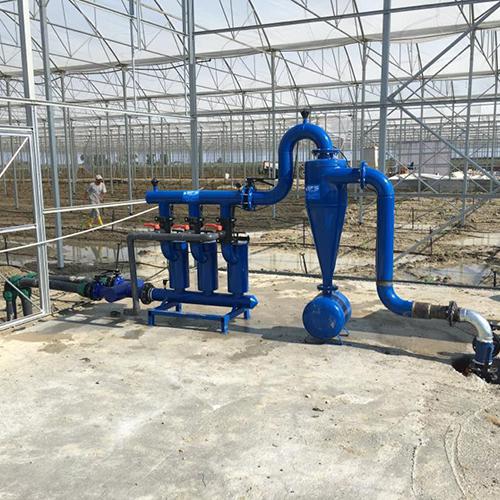
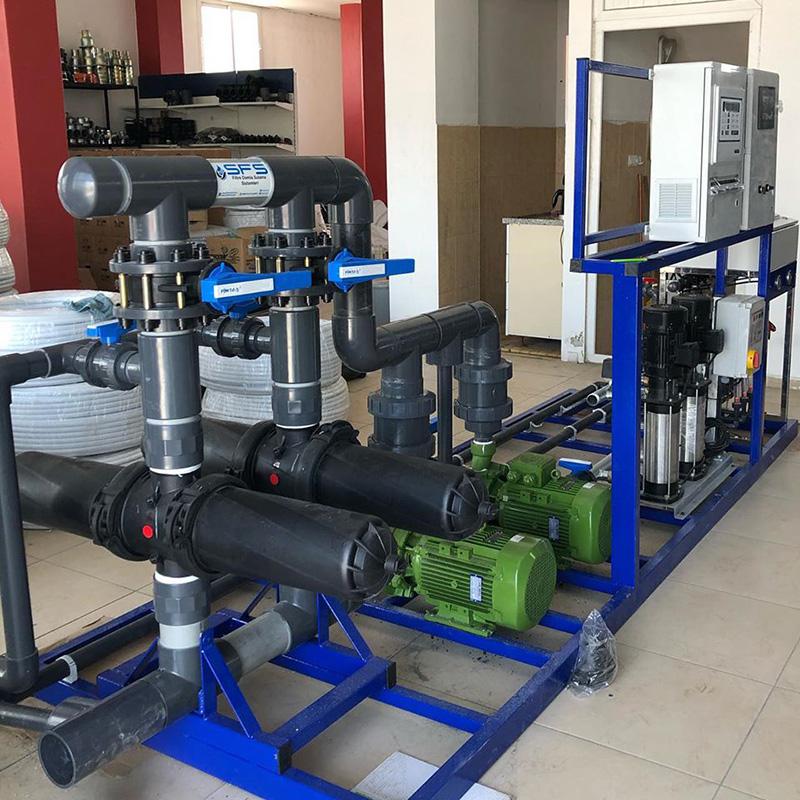
It has clearly seen necessary to use the centrifugal-separation-based filters, as primary filters, such as hydrocyclone and sand separator used in trials for separation of sand and other heavy particles found in water in the treatment of river water, and to use granular filters as secondary filters for separation of light material, i.e. organic material, algae, from water, and to use the disk and sieve filters as tertiary filters for safety. When load loss-time and flow-load loss results are examined, it can be said that the filters with large sieve surface area such as SF2 filters should be preferred as a tertiary filter because they can function longer without clogging and the load loss is less with them. Hydrocyclone and sand separators separate the particles in water that are denser than water itself, leaving them under the influence of centrifuges and gravitational forces. This is caused by the cycloid trajectory that water follows in the filter due to the special shapes of the filters, and the speed of the water and the particle carried with it is very important in terms of separation. Flow rate should be given importance while selecting these filters. In addition, economic conditions can also be taken into account in the selection of centrifugal separators where there are no significant differences in terms of efficiency and load loss. Hydrocyclone filters have a simpler structure and are cheaper than sand separators. Low efficiency values of hydrocyclone and sand separators obtained in the trial results should not be interpreted in a way that the use of these filters in river water is unnecessary. These types of filters, when used before granular filters, remove heavy particles such as sand, soil from water and hence reduce the load of the granular filter. Thus, the granular filter can serve for longer periods of time, without the need for frequent cleaning or backwashing. The size of granular filter depends entirely on the flow rate that is intended to be filtered. If the flow rate is too high, battery-shaped systems are recommended. In the drip irrigation systems, chemical substances are used for both preventing clogging and fertilization. A great majority of these substances are corrosive to iron. Therefore, all metal parts that will be used in drip irrigation systems are required to be well insulated and painted with appropriate paint and painting technology.
In order to use the canal water in drip irrigation systems, it is possible to create common-use pumping systems with filtration systems and make the water suitable for drip irrigation by making good project-designing and planning. With the help of systems with main control units, it is thought that it will provide significant benefits in terms of initial investment, operation, maintenance-repair and maintenance costs.